Sunni Distortions in Kitāb al-Amwāl and the erasure of the raid on Sayeda Fatimah’s (sa) House.
Ahl al-Sunnah have long worked tirelessly to construct a fairy tale in which there were no tensions between Abu Bakr and the Ahl al-Bayt following the death of the Prophet (s). Their goal is clear: to erase from history the injustice committed against the household of the Prophet (s) . The truth, however, is undeniable. Early sources explicitly record that Abu Bakrforcibly uncovered the house of Fatimah (sa), an act of aggression he later admitted with deep regret on his deathbed.
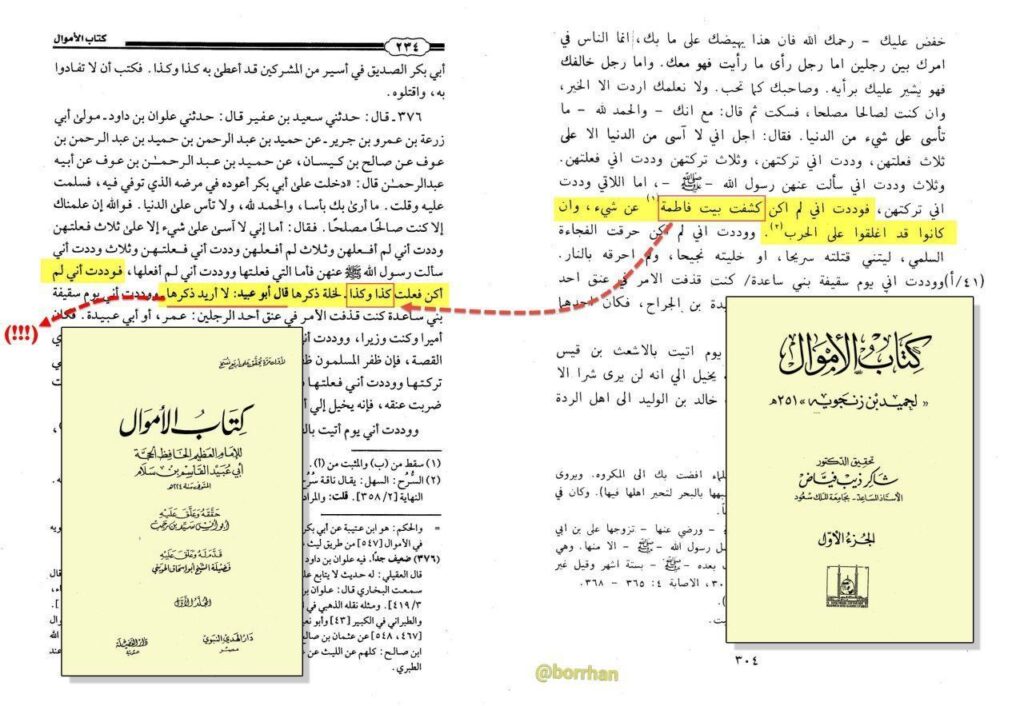
An early source, Ḥamīd ibn Zanjawayh (d. 251 AH), Kitāb al-Amwāl, leaves no room for doubt:
وأما التي فعلتها، فوددت أني لم اكن كشفت بيت فاطمة …
“I wish I had never uncovered (forcibly opened) Fatimah’s house…”
This is a blunt acknowledgment of wrongdoing. Abu Bakr names the house of Fatimah directly, showing the gravity of his act and the injustice inflicted upon the Prophet’s household.
Yet later Sunni editors, seeking to whitewash history, deliberately removed the explicit reference to Fatimah’s house. In the edition edited by Abū Isḥāq al-Ḥuwaynī, the text is sanitised:
وأما التي فعلتها، فوددت أني لم أفعلها …
“I wish I had not done them…”
Notice what has been done: the concrete acknowledgment of Abu Bakr’s intrusion is erased, leaving a vague, meaningless statement. This is not a minor variation or a matter of style; it is a deliberate act of distortion designed to protect the reputations of the early caliphs and erase the historical suffering of Sayeda Fatimah (sa).
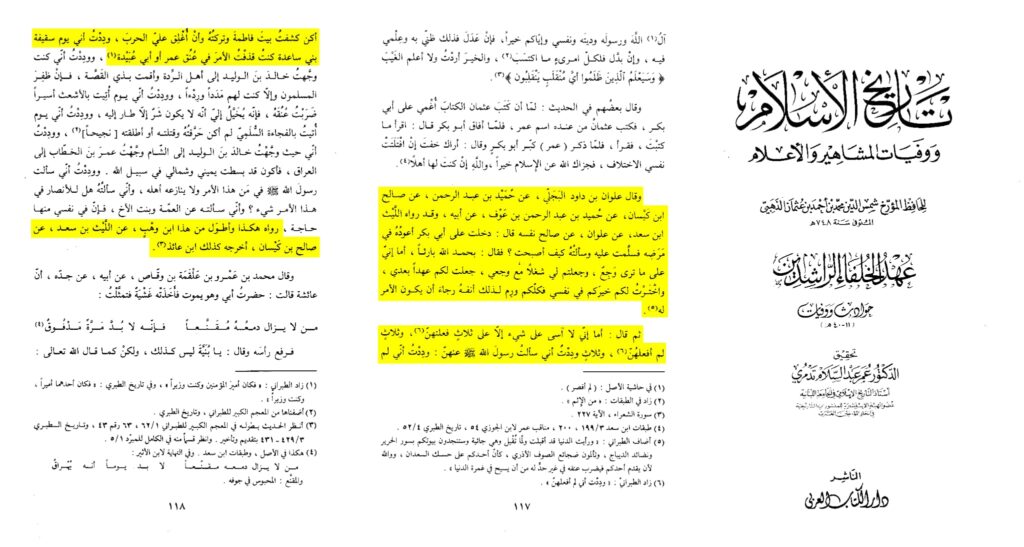
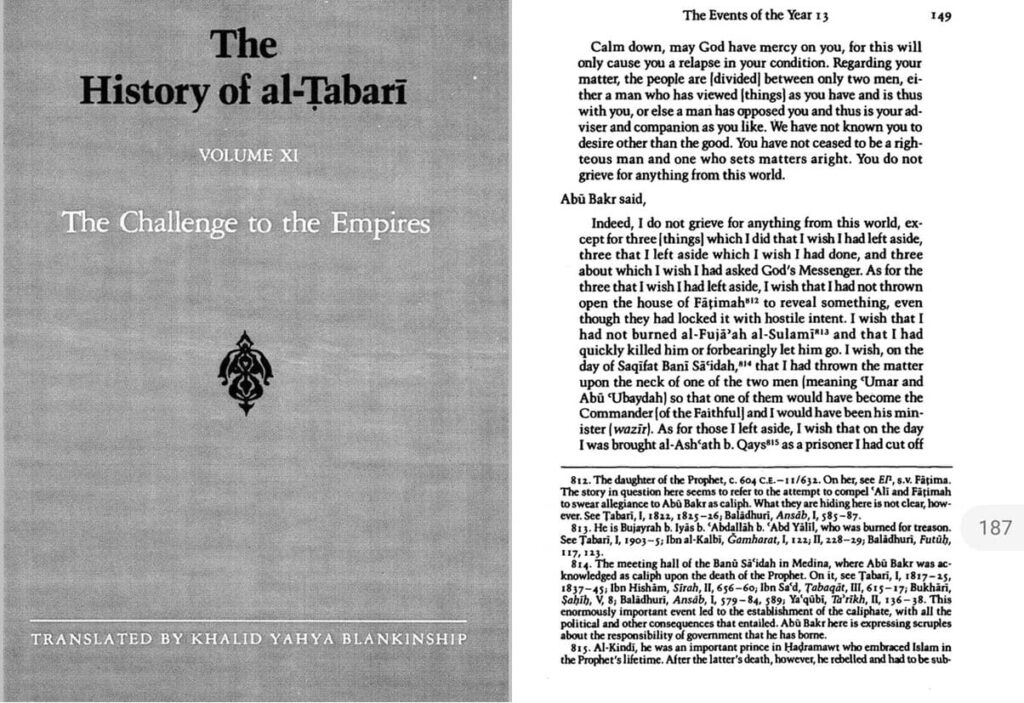
The historical reality is corroborated independently by Sunni authorities. Al-Dhahabī (d. 748 AH), Tārīkh al-Islām, Volume 3, pp. 117–118, and the English translation of al-Ṭabarī (d. 310 AH), The History of al-Ṭabarī, Volume 11, p. 149, record that Abu Bakr expressed three regrets on his deathbed, the first being: