Before birth, a child possesses no independent means of survival. Every breath of oxygen, every drop of nourishment, and every element necessary for growth reaches the foetus through one exclusive connection: the umbilical cord. While the mother is the source of life and sustenance, the umbilical cord is the divinely appointed conduit through which that sustenance flows. There is no alternative pathway, no rival connection, and no third party. This remarkable biological reality is itself one of Allah’s signs. Throughout creation, Allah appoints means (asbāb) through which His will is realised. The Messenger of Allah ﷺ employed a similarly profound image when he addressed the Muslim community shortly before his departure:
“Indeed, I am leaving among you that which, if you hold fast to it, you shall never go astray after me. One of them is greater than the other: the Book of Allah is a rope extended from heaven to earth, and my family—the people of my household—and they shall never separate until they return to me at the Pond. So consider how you will treat them after me.”
The Prophet ﷺ did not merely commend two separate authorities. Rather, he joined them together with an explicit declaration:
“They shall never separate.”
The Qur’an is described as a rope stretched from heaven to earth yet that heavenly rope is inseparably joined with the Ahl al-Bayt. Just as life reaches the unborn child through an uninterrupted, divinely appointed connection, so too the Prophet ﷺ teaches that guidance is preserved through a bond that can never be severed. History would soon attempt to prove otherwise.
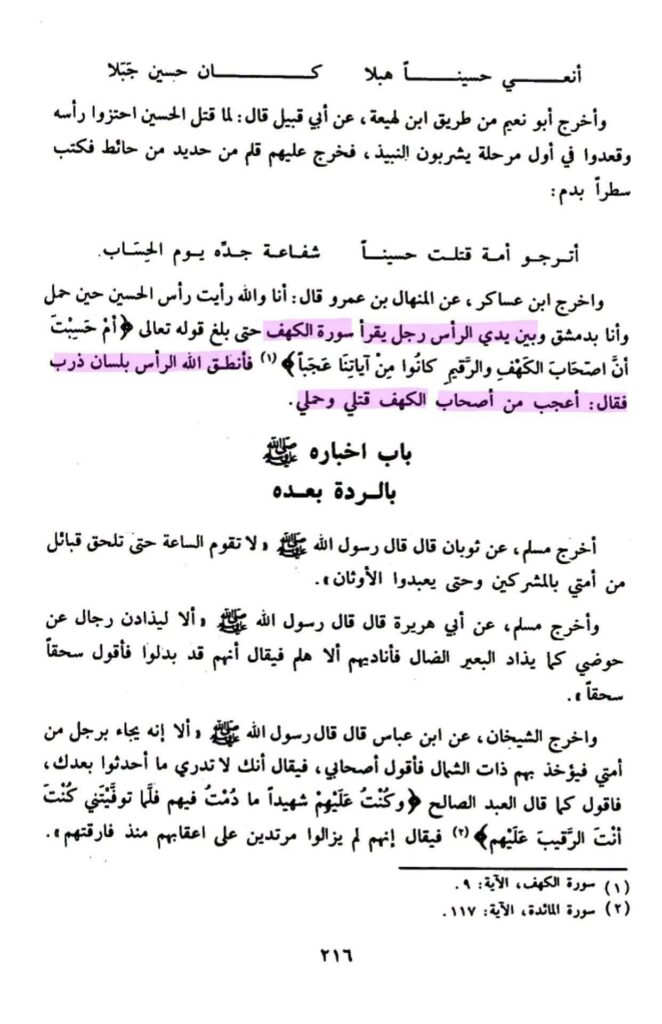
On the plains of Karbalāʾ, the blessed head of Imam al-Ḥusayn (ʿalayhi al-salām) was severed from his body. Those responsible imagined that by separating the head from the body they had extinguished his connection with the message of his grandfather. Yet the very opposite was manifested. The eminent Sunni historian Ibn ʿAsākir records that while the blessed head of Imam al-Ḥusayn (ʿalayhi al-salām) was being carried through Damascus, a man recited the verse:
At that moment, Allah caused the blessed head to speak, saying:
أعجب من أصحاب الكهف قتلي وحملي
“Or have you thought that the companions of the cave and the inscription were, among Our signs, a wonder?”” (Qur’an 18:9).
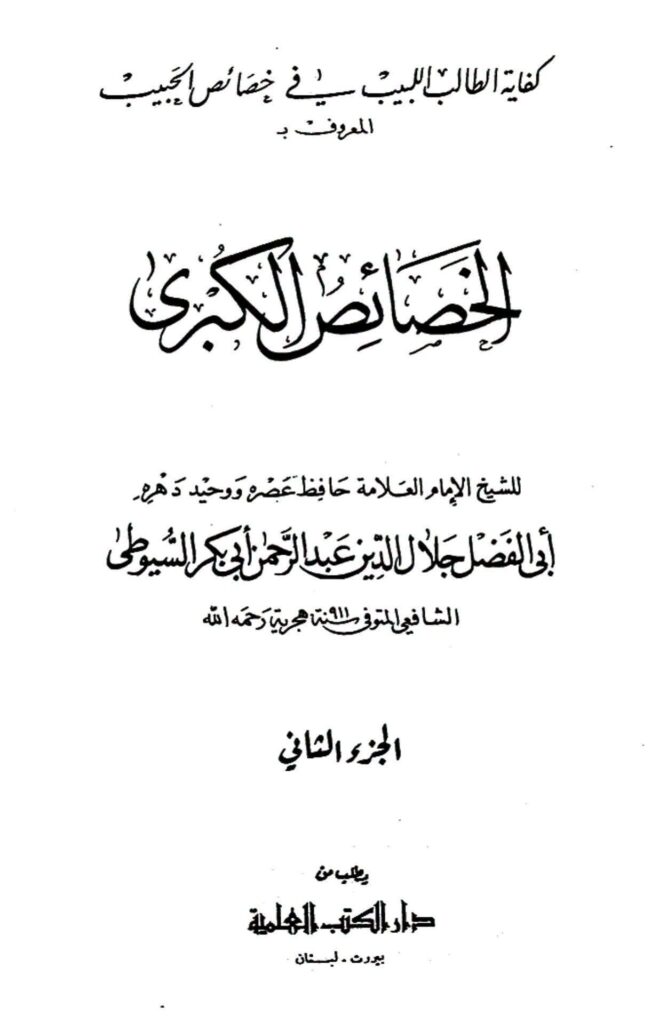
Jalāl al-Dīn al-Suyūṭī, al-Khaṣāʾiṣ al-Kubrā, vol. 2, p. 216. The passage cites the report of al-Manhāl ibn ʿAmr concerning the blessed head of Imam al-Ḥusayn (ʿalayhi al-salām) in Damascus.
(Ibn ʿAsākir, Tārīkh Madīnat Dimashq*, vol. 60, pp. 369–370. See also Jalāl al-Dīn al-Suyūṭī, *al-Khaṣāʾiṣ al-Kubrā*, vol. 2 (Beirut: Dār al-Kutub al-ʿIlmiyyah), p. 216, citing Ibn ʿAsākir. See also Kamāl al-Dīn al-Damīrī, *Ḥayāt al-Ḥayawān al-Kubrā*, vol. 1, p. 204, who likewise records a report of Imam al-Ḥusayn’s (ʿalayhi al-salām) blessed head speaking after martyrdom.)
The significance of this report lies not merely in its extraordinary nature, but in what it illustrates. Although the blessed head had been physically separated from the body, it remained inseparably connected to the Qur’an. The body had been divided by human hands, but the bond proclaimed by the Messenger of Allah ﷺ remained intact. The Prophet ﷺ had already declared that this would be so:
“They shall never separate until they return to me at the Pond.” Perhaps this is one of the profound lessons hidden within both creation and revelation. Just as Allah appointed an unbroken cord through which physical life reaches the unborn child, He likewise appointed an unbroken bond through which the life of guidance is preserved for the Ummah. Human beings may sever bodies, silence voices, and attempt to erase legacies, but they cannot undo what Allah and His Messenger ﷺ have joined together. The Qur’an and the Ahl al-Bayt remain exactly as the Messenger of Allah ﷺ promised: “They shall never separate.”