
Dishonesty by the Urdu translator of al Mustadrak.

Jan 11, 2026 | Deception, dishonesty by the Urdu translator of al Mustadrak.

Deception in Translation: How an Urdu rendering conceals Qur’anic rebuke


It is a foundational principle of Islamic scholarship that a narration must be assessed not only through its chain of transmission (isnād) and textual soundness (matn), but also through the integrity of its transmission in translation. When translation alters meaning, particularly where the text carries moral or theological weight—it ceases to be translation and becomes interpretation.

This article examines a clear case of semantic distortion in an Urdu rendering of a narration recorded by al-Ḥākim al-Naysābūrī (d. 405 AH) in Al-Mustadrak ʿalā al-Ṣaḥīḥayn, a narration that explicitly links the conduct of certain Companions to a Qur’anic rebuke.
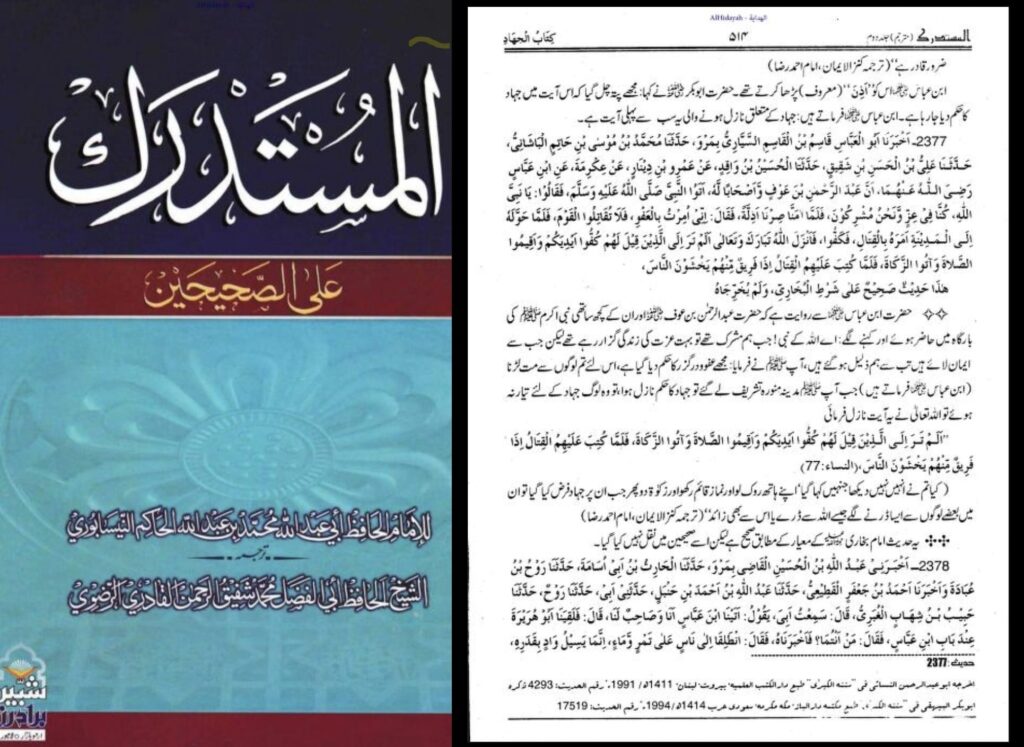
The Narration in Al-Mustadrak (Arabic Text)

The narration appears in Al-Mustadrak ʿalā al-Ṣaḥīḥayn, ḥadīth no. 2377. Al-Ḥākim graded it ṣaḥīḥ according to the conditions of al-Bukhārī, though it was not recorded by either al-Bukhārī or Muslim.

أخبرنا أبو العباس قاسم بن القاسم السياري بمرو، حدثنا محمد بن موسى بن حاتم الباشاني، حدثنا علي بن الحسن بن شقيق، حدثنا الحسين بن واقد، عن عمرو بن دينار، عن عكرمة، عن ابن عباس رضي الله عنهما،

أن عبد الرحمن بن عوف وأصحابًا له أتوا النبي صلى الله عليه وسلم، فقالوا: يا نبي الله، كنا في عز ونحن مشركون، فلما آمنا صرنا أذلة،

فقال:إني أُمرت بالعفو، فلا تقاتلوا القوم، فلما حوّله إلى المدينة أمره بالقتال، فَكَفُوا، فأنزل الله تبارك وتعالى:

أَلَمْ تَرَ إِلَى الَّذِينَ قِيلَ لَهُمْ كُفُّوا أَيْدِيَكُمْ وَأَقِيمُوا الصَّلَاةَ وَآتُوا الزَّكَاةَ، فَلَمَّا كُتِبَ عَلَيْهِمُ الْقِتَالُ إِذَا فَرِيقٌ مِّنْهُمْ يَخْشَوْنَ النَّاسَ كَخَشْيَةِ اللَّهِ أَوْ أَشَدَّ خَشْيَةً 

[النساء: 77]

هذا حديث صحيح على شرط البخاري ولم يخرجاه

Ibn ʿAbbās reported:

ʿAbd al-Raḥmān ibn ʿAwf and some of his companions came to the Prophet (peace be upon him) and said, “O Prophet of Allah, we used to live in honour while we were polytheists, but when we believed, we became humiliated.”

He replied, “I have been commanded to pardon, so do not fight the people.”

Then, when Allah transferred him to Madinah, He commanded him to fight—but they held back. Thereupon Allah, Blessed and Exalted, revealed:

“Have you not seen those to whom it was said: ‘Restrain your hands, establish prayer, and give zakah’? But when fighting was prescribed for them, a group among them feared the people as they should have feared Allah, or even more. They said, ‘Our Lord, why have You prescribed fighting for us? If only You had delayed it for us for a short time.’ Say: the enjoyment of this world is little, and the Hereafter is better for those who are mindful, and you will not be wronged even to the extent of a thread.”
(Qur’an 4:77)

Al-Ḥākim states: “This ḥadīth is ṣaḥīḥ according to the conditions of al-Bukhārī, though they did not record it.”

The Urdu Translation and the Point of Distortion

In a widely circulated Urdu translation, the critical phrase فَكَفُوا is rendered as:

تیار نہ ہوئے

“they were not ready” when it should read but they held back.

At first glance, this may appear innocuous. In reality, it introduces a substantive shift in meaning.

 Observation One: The Arabic Attributes Deliberate Withholding

In the Arabic narration, فَكَفُوا follows immediately after the command to fight. The sequence is explicit: the command was issued, then they withheld themselves. This wording attributes agency—a conscious choice in response to a divine command—not incapacity or circumstantial delay.

Observation Two: Lane’s Lexicon Fixes the Meaning

According to Lane’s Arabic–English Lexicon, one of the most authoritative references for classical Arabic:

كَفَّ عَنْهُ

“He refrained, desisted, forbore, abstained, or held back from it; he left it, relinquished it, or forsook it.”

This entry is available online:
https://www.arabic-english-dictionary.com/content/22_k/126_kf

Lane’s definition leaves no lexical room for “not ready”. The verb denotes active restraint or abstention, not lack of preparation or incapacity.

Observation Three: The Qur’anic Context Confirms Moral Failure

The narration explicitly identifies the Companions’ conduct as the occasion of revelation (asbāb al-nuzūl) for Qur’an 4:77. The verse censures those who, when fighting became obligatory, feared people instead of Allah. Fear is a moral choice, not a reflection of logistical unreadiness.

Observation Four: The Urdu Rendering Neutralises the Rebuke

By translating فَكَفُوا as “they were not ready”, the Urdu version reframes deliberate withholding as passive circumstance. In doing so, it removes the moral accountability that the Qur’an intended and shields the Companions from the clear rebuke of divine instruction.

To illustrate this distortion for a general reader, consider a simple example: if a teacher instructs students to submit assignments by Friday, and some students consciously choose not to submit, a faithful report would state that the students refused to submit, highlighting their deliberate choice. Translating it instead as “the students were not ready” removes their agency, reframes the action as circumstantial, and softens the perception of fault. The same principle applies to فَكَفُوا: the companions’ deliberate restraint in response to a divine command is recast as mere unreadiness, erasing responsibility and diluting the moral rebuke intended by both the hadith and Qur’an 4:77

Conclusion

The Arabic narration preserved by al-Ḥākim al-Naysābūrī records a moment of moral hesitation among recognised Companions and explicitly links that hesitation to a Qur’anic rebuke. The language is clear, deliberate, and lexically fixed.

The Urdu translation, by substituting unreadiness for withholding, alters the meaning of the text and neutralises both the hadith and the Qur’anic context. Lane’s Lexicon confirms that this substitution has no basis in the Arabic language.

Faithfulness to the Qur’an and the Sunnah requires fidelity to their language, not protection of reputations at the expense of truth.