
ʿUmar’s Innovation in Prayer’
ʿUmar ibn al-Khaṭṭāb, during his period of governance, introduced several practices regarded as religious innovations (bidʿah). One such practice was the congregational prayer known as Ṭarāwīḥ, which he initiated in Madīnah contrary to the practice of the Prophet ﷺ. The Prophet ﷺ had explicitly discouraged companions from performing voluntary night prayers in continuous congregation.
The Prophet ﷺ strictly forbade innovation. Muslim reports from Jabir ibn ʿAbdullāh (RA) state:
“Every newly invented matter is an innovation, and every innovation is misguidance.”
Reference: Sahih Muslim, Kitāb al-Jumuʿah, Bab Takhfīf al-Ṣalāh wa al-Khuṭbah, Hadith 2005
Sunan an-Nasāʾī also reports with a sound chain (Hadith 1578):
“The truest of word is the Book of Allah and best of guidance is the guidance of Muḥammad ﷺ. The worst of things are those that are newly invented; every newly-invented thing is an innovation and every innovation is going astray, and every going astray is in the Fire.”
Reference: Sunan an-Nasāʾī, Hadith 1578
If innovation is carried out in the sacred precincts of Madīnah, it carries a severe sin. Bukhārī narrates from Anas ibn Mālik and ʿAlī ibn Abī Ṭālib (AS):
“Madīnah is sacred from such and such to such and such (from Mount ʿAir to Thawr). No tree should be cut, nor any innovation introduced therein; whoever does so, Allah, the angels, and all people curse him.”
Reference: Sahih Bukhārī, Hadith 1867
ʿAlī ibn Abī Ṭālib (AS) further reports:
“The Prophet ﷺ said: Madīnah is sacred from place to place; whoever introduces an innovation therein, the curse of Allah, the angels, and all people is upon him, and no act of worship he performs will be accepted, neither obligatory nor voluntary.”
Reference: Sahih Bukhārī, Kitāb Faḍāʾil al-Madīnah, Hadith 1870
These narrations establish the seriousness with which innovation in matters of worship was treated.
Voluntary Ramadan Prayers
From Ṣaḥīḥ Bukhārī (Hadith 731):
“The Prophet ﷺ used to pray during Ramaḍān in the mosque. People used to pray behind him for a few nights. On the fourth night, the mosque was full, and the Prophet ﷺ did not come out. They called him and began to strike small stones at the door to attract his attention. When morning came, the Prophet ﷺ came out and said: ‘I feared that it would be made obligatory upon you. The best prayer of a person is that which he prays in his house, except the obligatory prayers.’”
Reference: Ṣaḥīḥ Bukhārī, Hadith 731
From Ṣaḥīḥ Muslim (Hadith 1826):
“The Prophet ﷺ prayed in the mosque during Ramaḍān for a few nights. People gathered to pray behind him. On the fourth night, they called him persistently, and some even threw small pebbles toward his door to draw his attention. When the morning came, he ﷺ addressed them and said: ‘Nothing prevented me from coming out except that I feared that it would become obligatory upon you. The best prayer of a person is in his house, except for the obligatory prayers.’”
Reference: Ṣaḥīḥ Muslim, Kitāb Ṣalāt al-Muṣāfirīn, Hadith 1826
Key lessons from these narrations:
1. Companions initially prayed behind the Prophet ﷺ without his prior instruction.
2. When he did not come out, they showed boldness, even throwing stones at the door.
3. The Prophet ﷺ was displeased and became angry at their insistence.
4. He clarified that if this prayer were made obligatory, people would struggle to perform it consistently.
5. Voluntary prayers should be performed at home, not institutionalised in congregation.
ʿUmar’s Congregational Ṭarāwīḥ in Madīnah
Despite these warnings, ʿUmar introduced congregational Ṭarāwīḥ in Madīnah itself, linking directly to the prophetic warnings about innovation:
“I went out with ʿUmar ibn al-Khaṭṭāb one night in Ramaḍān to the mosque. People were praying scattered individually. ʿUmar said: ‘If these were gathered behind one reciter, it would have been better.’ Then he gathered them behind Abū ʿAbdullāh ibn Kaʿb. On another night, people followed their own reciter again, and ʿUmar said: ‘Yes, this is innovation.’”
Reference: Ṣaḥīḥ Bukhārī, Hadith 731
This establishes that the formalisation of congregational Ṭarāwīḥ occurred within the sacred precincts of Madīnah, directly relating to the earlier warnings of curse and misguidance for innovations in that location.
Analytical Clarification
It may be argued that the Prophet’s fear of obligation ceased upon his death, and thus the preventative reason for withdrawal no longer applied. From this perspective, the later organisation of congregational Ṭarāwīḥ would be seen not as alteration, but as the removal of a temporary barrier.
However, this reasoning does not alter the structural reality of the prophetic precedent.
The Prophet ﷺ had both the opportunity and the authority to institutionalise the practice permanently. He did not do so. More significantly, he actively withdrew from sustained congregational performance and provided a reason that became part of the transmitted Sunnah itself. His non-continuation was not silence; it was deliberate restraint.In devotional law, omission can carry normative weight. When the Messenger ﷺ refrains from formalising a voluntary act into a regulated communal institution — despite clear ability to do so — that restraint becomes instructive. The Sunnah is defined not only by what he performed, but also by what he intentionally left unstructured.
Thus, transforming a non-institutional voluntary act into a nightly, organised communal ritual introduces a new structural form into worship. The change is not in the prayer itself, but in its institutional framing.
That distinction is decisive.
This distinction is not merely polemical. It is explicitly acknowledged within Sunni scholarship itself.
The late Hanafi scholar Ustādh Ghulām Rasūl Saʿīdī, in Sharḥ Ṣaḥīḥ Muslim (vol. 2, p. 542), writes:
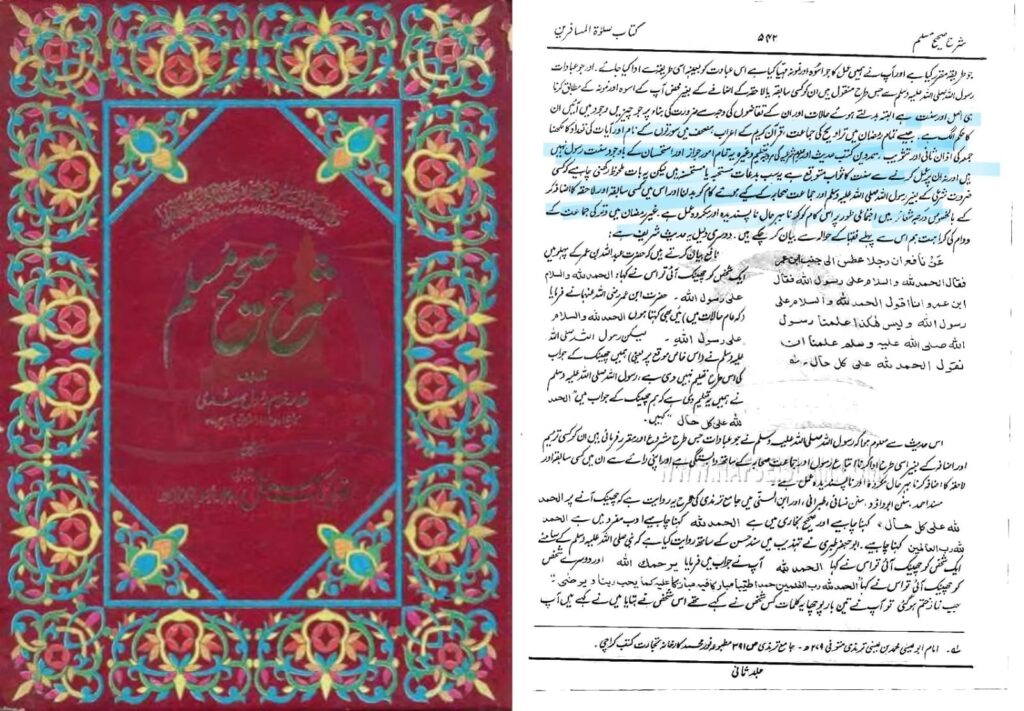
“The preferred method is that the practice which the Messenger of Allah ﷺ established and made available for us should be performed exactly in the same manner. The expressions of the Messenger of Allah ﷺ, as they have been transmitted, are to be followed purely in accordance with his example and Sunnah, without any addition or alteration.
However, due to changing circumstances and emerging needs, certain practices came into existence. For example: establishing congregational Tarāwīḥ throughout the entire month of Ramadan…
All of these matters, despite being permissible and beneficial, are not from the Sunnah of the Messenger ﷺ… Rather, they fall under recommended or commendable innovations.”
This admission is significant for three reasons:
1. It affirms that Sunnah must be followed without addition or alteration.
2. It acknowledges that sustained congregational Ṭarāwīḥ was not established by the Prophet ﷺ in that format.
3. It categorises the practice as a later innovation, even if deemed beneficial.
This admission removes the final ambiguity. The debate can no longer be framed as a dispute over isolated narrations or terminology. The prophetic precedent is acknowledged. The later institutional development is acknowledged. The distinction between the two is conceded.
What remains is a question of fidelity: is devotional structure determined by prophetic institution, or by later commendation?
Labeling congregational Ṭarāwīḥ a “commendable innovation” does not resolve the issue; it confirms it. The examples often cited alongside it — such as compiling the muṣḥaf or codifying ḥadīth — are preservational measures. They safeguard revelation; they do not alter the structure of worship itself.
Congregational Ṭarāwīḥ, however, concerns the formal structuring of a devotional act. It converts what the Prophet ﷺ deliberately left non-institutional into a regulated communal ritual.
Preservation protects form. Institutionalisation modifies it.
In acts of worship, form is legislated. To describe the practice as a “good innovation” concedes its non-prophetic origin; the classification does not remove that reality.
Conclusion
The evidences now converge.
The Prophet ﷺ prayed voluntary night prayer in Ramaḍān. He allowed companions to join him briefly. Then he withdrew deliberately and prevented its sustained institutionalisation. He clarified that voluntary prayer is superior in the home. He left no ongoing organised congregational model for the month.
Later, in Madīnah, the city whose sanctity magnifies religious alteration congregational Ṭarāwīḥ was formally organised and described explicitly as an innovation.
Even scholars who defend its permissibility concede that it is not from the Sunnah of the Messenger ﷺ in its institutionalised form.
The question therefore cannot be reduced to communal benefit or historical development. The decisive inquiry is simple:
Did the Prophet ﷺ establish a continuous, regulated congregational Ṭarāwīḥ for Ramaḍān?
The transmitted record answers in the negative.
· He withdrew.
· He restrained formalisation.
· He preferred voluntary devotion in the home.
What followed was not the continuation of an established prophetic institution, but the introduction of a structured communal format after him.In devotional matters, precision defines fidelity. The prophetic model was complete. To preserve its boundaries is adherence; to extend them structurally is innovation.And in worship, innovation is not an embellishment of the Sunnah, it is departure from its defined form.