Introduction
When discussing the virtues of the Ahl al-Bayt (peace be upon them) with the Nawāṣib, one quickly notices a familiar pattern. Their approach resembles that of a lawyer instructed to oppose a planning application at all costs. He first argues that the application is legally defective. If that argument fails, he challenges the evidence. If the evidence proves sound, he disputes the procedure. If that too fails, he searches for another technicality in the hope of delaying or preventing implementation. At no stage is he asking, “What is true?” Rather, his sole objective is to ensure that the application never succeeds.
Likewise, when confronted with narrations concerning the virtues of the Ahl al-Bayt (peace be upon them), the Nawāṣib begin with a predetermined conclusion: the report must not be accepted. If they are unaware of its existence in their own books, they dismiss it as a “Shīʿī fabrication.” Once it is demonstrated that the same narration exists in recognised Sunni sources, they immediately change tactics and begin searching for any conceivable means of weakening, denying, or explaining it away.
A clear example of this methodology can be seen in the writings of one of the leading voices of modern Nāsibism, Shaykh Iḥsān Ilāhī Ẓahīr. In Shīʿah wa Ahl al-Bayt (p. 293), he writes:
“As for the one who is unable to visit al-Ḥusayn, then the least he should do is weep over his martyrdom; and for him too is Paradise… A tear is not shed over the martyrdom of al-Ḥusayn except that Allah forgives his sins, even if they be as much as the foam of the ocean… Paradise becomes obligatory for him… Likewise, whoever weeps over al-Riḍā, for him is Paradise.”
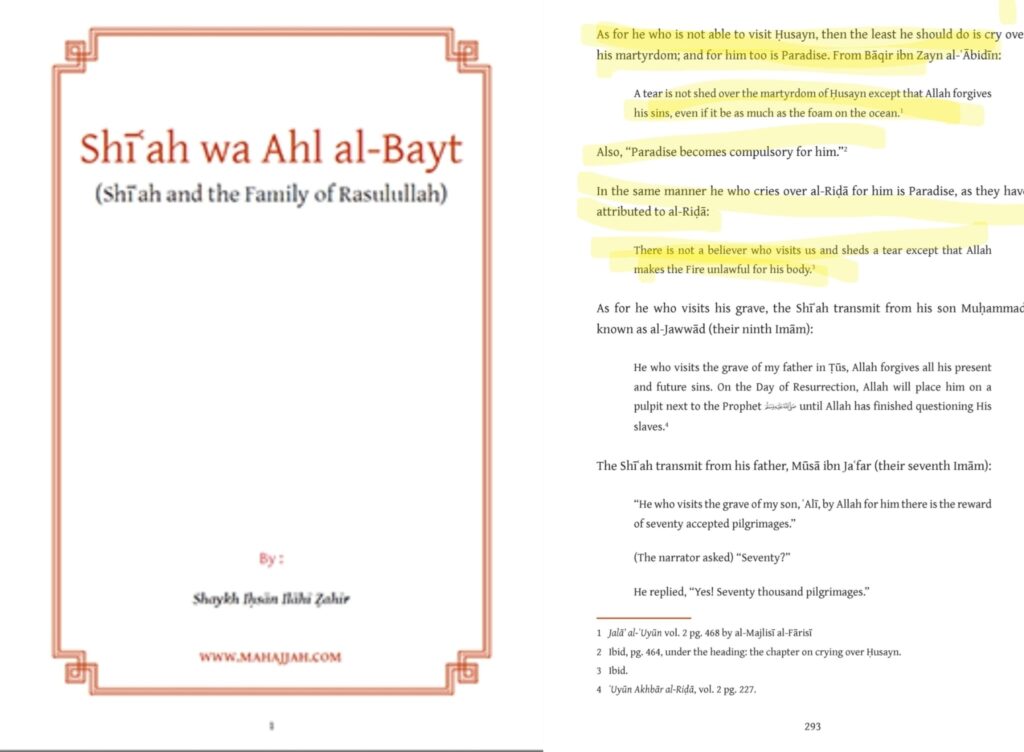
“As for the one who is unable to visit al-Ḥusayn, then the least he should do is weep over his martyrdom; and for him too is Paradise… A tear is not shed over the martyrdom of al-Ḥusayn except that Allah forgives his sins, even if they be as much as the foam of the ocean… Paradise becomes obligatory for him… Likewise, whoever weeps over al-Riḍā, for him is Paradise.”
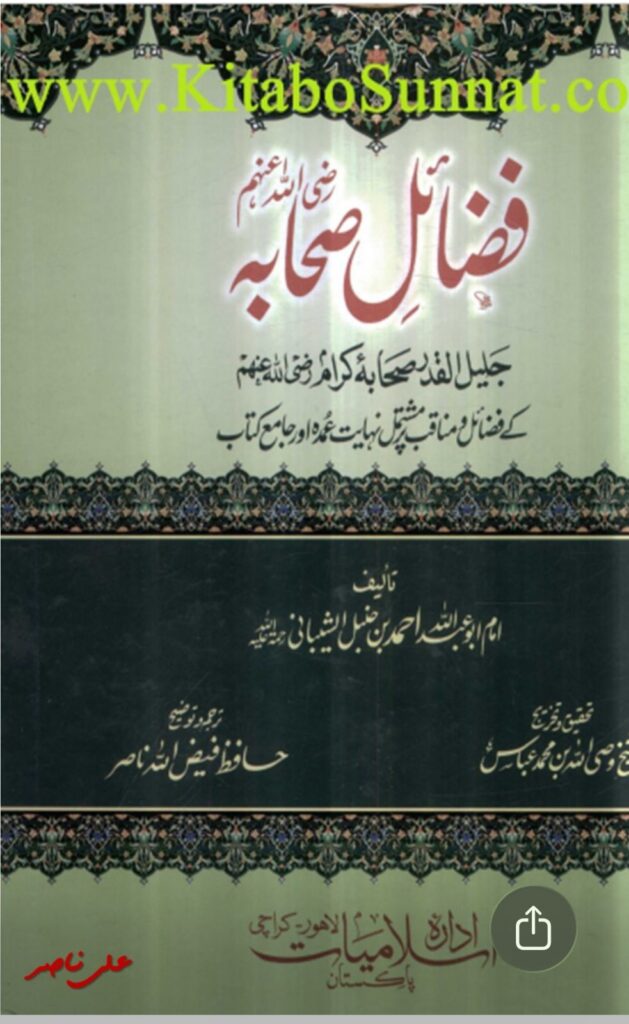
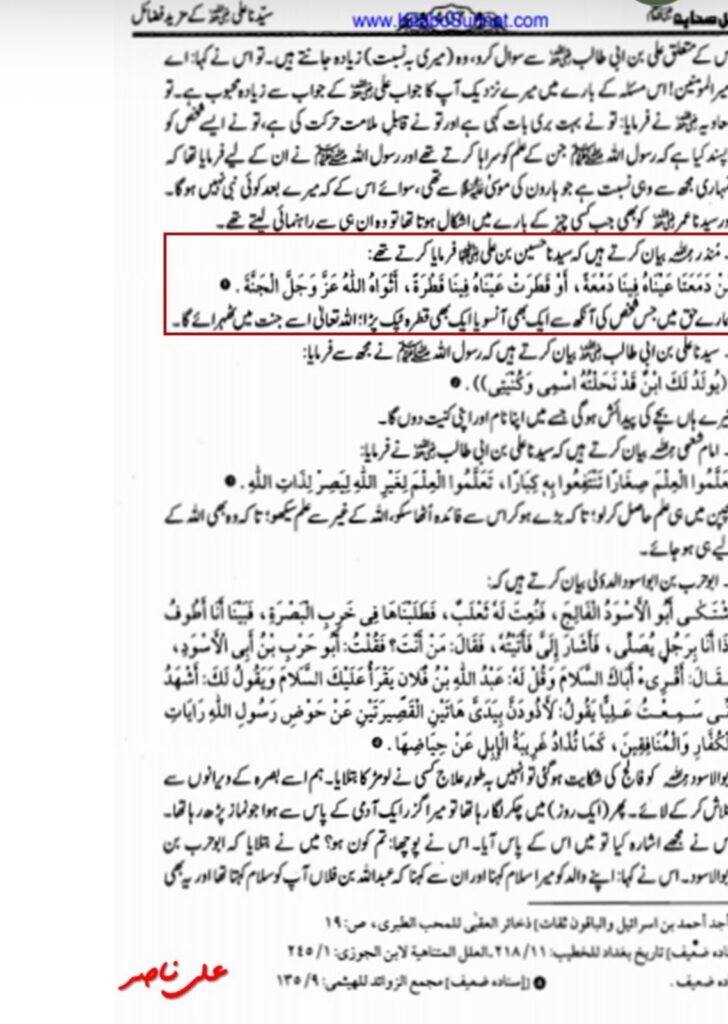
Having cited these narrations, he leaves the reader with the impression that such beliefs are uniquely Shīʿī and therefore objectionable. What he fails to inform his readership is that the very same concept is explicitly found in Sunni hadith literature. Imam Aḥmad ibn Ḥanbal narrates in Faḍāʾil al-Ṣaḥābah that the Master of Martyrs, Imam al-Ḥusayn (peace be upon him), said:
مَنْ دَمَعَتْ عَيْنَاهُ فِينَا دَمْعَةً، أَوْ قَطَرَتْ عَيْنَاهُ فِينَا قَطْرَةً، أَثْوَاهُ اللَّهُ عَزَّ وَجَلَّ الْجَنَّةَ
“Whoever’s eyes shed a tear for us, or whose eyes let fall even a single drop for us, Allah, Mighty and Majestic, will grant him Paradise.”
(Faḍāʾil al-Ṣaḥābah, no. 1154)
The existence of this narration in Sunni sources places the Nawāṣib in an uncomfortable position. They can no longer dismiss the report as a purely Shīʿī invention. Instead, they are compelled to embark upon the familiar exercise of manufacturing objections in an attempt to deny its implications.
The religion of the Nawāṣib is one of denial. They reject every report that manifests the virtues of the Ahl al-Bayt (peace be upon them), regardless of its provenance or authenticity. What else can be expected from a methodology inherited from Banū Umayyah?
The narration concerning weeping for Imam al-Ḥusayn (peace be upon him) is particularly troublesome for them because many among them have already declared mourning and weeping to be a bidʿah (innovation). How, then, can they reconcile such pronouncements with a narration promising Paradise for shedding even a single tear for the family of the Messenger of Allah (peace and blessings be upon him and his family)? And once the reward for such grief is established, another question naturally arises: who were the individuals whose crimes were so grave that mourning their victims became an act rewarded with Paradise?
In response to one such objector, Maulana Sayyid Abu Hasham Najafi authored a detailed written refutation. Since these same tired objections continue to be repeated by the followers of Banū Umayyah, he deemed it necessary to expose, in writing, the inconsistencies, deceptions, and selective methodology that characterise their treatment of narrations concerning the virtues of the Ahl al-Bayt (peace be upon them). May Allah increase him in success and accept his efforts.
Shiapen Team
A Sahih Chain Hadith in Fada’il al-Sahaba by Ahmad ibn Hanbal
Ahmad ibn Hanbal narrates with a sahih chain from Imam Husayn (peace be upon him):
حدثنا أحمد بن إسرائيل قال: رأيت في كتاب أحمد بن محمد بن حنبل رحمه الله بخط يده: نا أسود بن عامر أبو عبد الرحمن قثنا الربيع بن منذر، عن أبيه قال: كان حسين بن علي يقول: من دمعتا عيناه فينا دمعة، أو قطرَت عيناه فينا قطرة، أثواه الله عز وجل الجنة.
Munzir reports that Imam Husayn (peace be upon him) used to say:
“Whoever’s eyes shed a tear for us, or whose eyes dropped a single tear for us, Allah, Mighty and Glorious, will grant him Paradise.”
[Fada’il al-Sahaba, by Ahmad ibn Muhammad ibn Hanbal al-Shaybani (d. 241 AH),
ed. Dr. Wasiullah Muhammad Abbas, Mu’assasat al-Risalah – Beirut, 1st edition, 1403 AH – 1983 CE, vol. 2, p. 575, Hadith no. 1154]
https://shamela.ws/book/13136/1132