Imam Ali’s Testimony and Sunni Self-Censorship: A Comparative Analysis of Kitab al-Sunnah and Ansāb al-Ashrāf
Dec 7, 2025 | Deception
Imam Ali’s Testimony and Sunni Self-Censorship: A Comparative Analysis of Kitab al-Sunnah and Ansāb al-Ashrāf
The events immediately following the death of the Prophet Muhammad ﷺ are recorded in multiple Sunni sources. Among these, Imam Ali’s (as) reflections on the political succession are particularly revealing. Comparing two major Sunni compilations Ansāb al-Ashrāf of al-Balādhurī and Kitab al-Sunnah of Imam Ahmad ibn Hanbal — highlights subtle patterns of editorial softening or omission. These differences illuminate Sunni self-censorship and clarify the true meaning of phrases like
“فبايعت ورضيت وسلمت”
“I pledged, was content, and submitted.”
1. The Report in Ansāb al-Ashrāf (Kitab Mujmal, Vol. 2, p. 402)
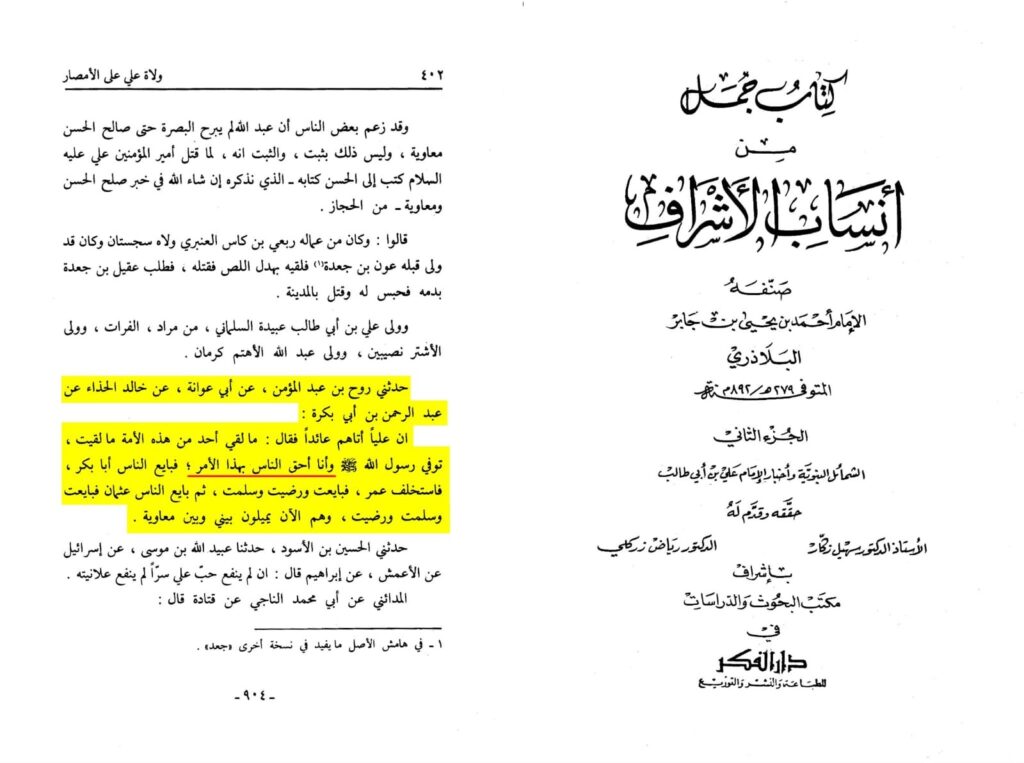
The source is from:
Kitab Mujmal min Ansāb al-Ashrāf, authored by imam Ahmad ibn Yahya ibn Jabir al-Balādhurī (d. 279 AH / 892 CE),
Volume 2, Al-Shamā’il al-Nabawiyyah wa Akhbār al-Imām Ali ibn Abi Talib,
Edited and introduced by Prof. Suhail Zakkāt and Dr. Riyāḍ Zarkalī,
Supervised by the Office of Research and Studies, Dar al-Fikr, p. 402.
Al-Balādhurī transmits the narration via Rawh ibn ‘Abd al-Mu’min → Abu ‘Awanah → Khalid al-Hadhdhā’ → ‘Abd al-Rahman ibn Abi Bakrah. In Arabic:
حدثني روح بن عبد المؤمن ، عن أبي عوانة ، عن خالد الحذاء ، عن عبد الرحمن بن أبي بكرةأن علياً أتاهم عائداً فقال : ما لقي أحد من هذه الأمة ما لقيت ،توفي رسول الله ﷺ وأنا أحق الناس بهذا الأمر ؛ فبايع الناس أبا بكر ، فاستخلف عمر ، فبايعت ورضيت وسلمت ، ثم بايع الناس عثمان فبايعت وسلمت ورضيت ، وهم الآن يميلون بيني وبين معاوية
‘Ali (as) came to visit them and said:
“No one from this Ummah has endured what I have endured. The Messenger of Allah ﷺ passed away while I was the most deserving of this affair. Yet the people pledged allegiance to Abu Bakr, and Abu Bakr appointed ‘Umar, so I pledged, was content, and submitted. Then the people pledged allegiance to ‘Uthman, and I pledged, was content, and submitted. And now they waver between me and Mu‘awiyah.”
This version is concise and neutral. It communicates sorrow and endurance but omits dialogue, oaths, or companions’ involvement, flattening Imam Ali’s moral and spiritual stance.
2. The Report in Kitab al-Sunnah (Vol. 2, pp. 563–564)
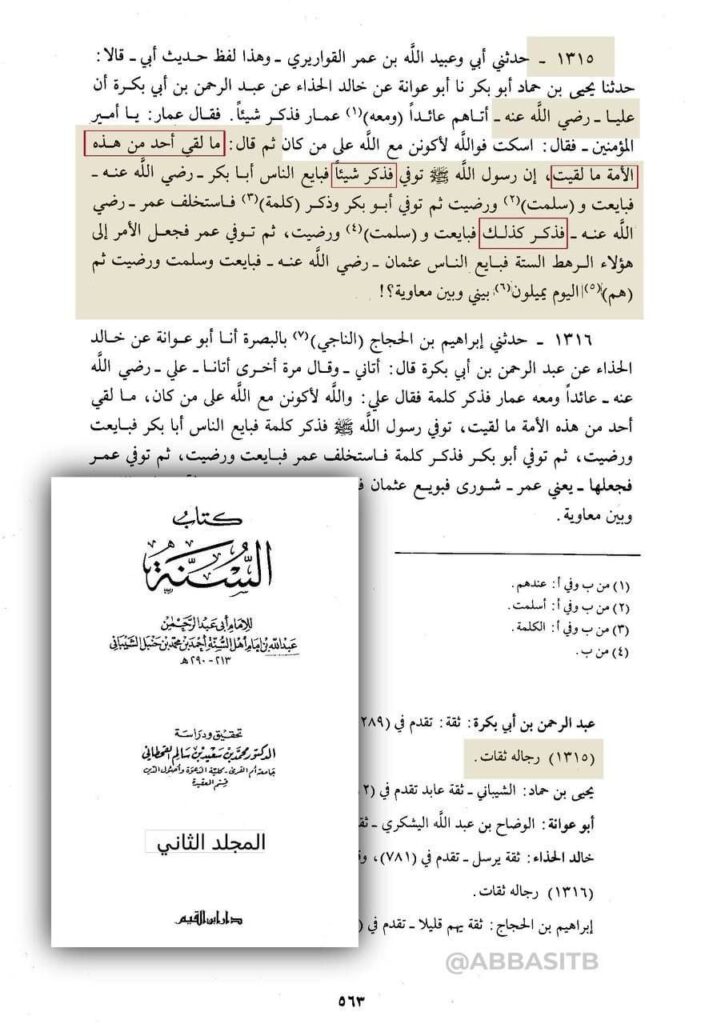
The source is:
Kitab al-Sunnah by Abdullah Ibn Ahmad ibn Hanbal (d. 241 AH), Volume 2, pp. 563–564, as published in Tahqiq wa Dirasah by Dr. Muhammad bin Sa‘id bin Salim al-Qahtani,
College of Da‘wah and Usul al-Din, Umm al-Qura University.
Abdullah ibn Ahmad ibn Hanbal preserves the narration with Yahya ibn Hammad → Abu ‘Awanah → Khalid al-Hadhdhā’ → ‘Abd al-Rahman ibn Abi Bakrah. In Arabic:
حدثني أبي وعبيد الله بن عمر القواريري – وهذا لفظ حديث أبي – قالا حدثنا يحيى بن حماد أبو بكر ، قال : نا أبو عوانة ، عن خالد الحذاء ، عن عبد الرحمن بن أبي بكرةأن علياً أتاهم عائداً (ومعه عمار) فذكر شيئاً. فقال عمار: يا أمير المؤمنين.فقال: اسكت، فوالله لأكونن مع الله على منكان.ثم قال: ما لقي أحد من هذه الأمة ما لقيت، إن رسول الله ﷺ توفي فذكر شيئاً، فبايع الناس أبا بكر، فبايعت وسلمت ورضيت.ثم توفي أبو بكر فذكر كلمة، فاستخلف عمر فذكر كذلك، فبايعت وسلمت ورضيت.ثم توفي عمر فجعل الأمر إلى هؤلاء الرهط الستة، فبايع الناس عثمان فبايعت وسلمت ورضيت.ثم هم اليوم يميلون بيني وبين معاوية؟!
‘Ali (as) came to visit them, and with him was ‘Ammār ibn Yasir. He mentioned something, and ‘Ammār said, “O Commander of the Faithful.”
Ali said: “Be silent! By Allah, I will indeed be with Allah against whomever it may be.”
Then he said: “No one from this Ummah has faced what I have faced. The Messenger of Allah ﷺ passed away… then the people pledged allegiance to Abu Bakr, so I pledged, submitted, and was content. Then Abu Bakr passed away and appointed ‘Umar, so I pledged, submitted, and was content. Then ‘Umar died and placed the matter among six men, so the people pledged allegiance to ‘Uthman; and I pledged, submitted, and was content. And now today they waver between me and Mu‘awiyah?!”
3. Comparison and Evidence of Self-Censorship
While both narrations share the same chain from Abu ‘Awanah onward, the differences are instructive:
-
Presence of Ammar ibn Yasir: Only Kitab al-Sunnah records that ‘Ammār accompanied Imam Ali (as), signaling that this statement occurred under witness to loyalty and moral support. Ansāb al-Ashrāf omits him entirely.
-
Use of the title “Amir al-Mu’minin”: In Abdullah ibn Ahmad Ibn Hanbal, ‘Ammār addresses Ali as Commander of the Faithful, acknowledging his rightful leadership. Al-Balādhurī deletes this acknowledgment.
-
Divine oath: Abdullah Ibn Ahmad preserves Ali’s statement: “By Allah, I will indeed be with Allah against whomever it may be”, asserting his unwavering moral and divine alignment. Al-Balādhurī omits this entirely.
-
Reference to the Shura of six: Only Abdullah Ibn Ahmad mentions the political mechanism after ‘Umar’s death, clarifying the process by which Ali’s claim was sidelined.
These omissions in Balādhurī’s version neutralize Ali’s testimony, transforming it from a declaration of principled resistance into a passive account of historical events.
4. Understanding “I Pledged, Submitted, and Was Content” in Context
A central point of interpretation is the phrase
“فبايعت ورضيت وسلمت”
“I pledged, was content, and submitted.”
Sunni polemic often uses this to argue that Imam Ali (as) ultimately approved of the early caliphs. Careful reading of language, context, and history demonstrates that it describes external acquiescence under duress, not internal satisfaction or endorsement.
The verb سَلَّمْتُ (sallamtu) signifies yielding or restraint, not endorsement. In Qur’anic usage, submission occurs even under grief, reflecting obedience or preservation rather than inner contentment. Consider the story of Ibrahim (as) and his son in Surah As-Saffat (37:103):
فَلَمَّا أَسْلَمَا وَتَلَّهُ لِلْجَبِينِ
“Then when they had both submitted (aslamā) and he laid him on his forehead.”
Here, submission occurs under extreme emotional difficulty; the act of surrender does not imply that Ibrahim (as) was pleased, but that he obeyed God while enduring profound grief. Similarly, Imam Ali’s (as) sallamtu represents strategic compliance and restraint to prevent division within the Ummah, not approval of the actions of others.
His “contentment” (radiytu) cannot indicate approval of wrongdoing. As the Qur’an commands, patience and strategic restraint are virtuous when they protect the greater good. Imam Ali (as) himself explains in Nahj al-Balāghah, Sermon 3:.
“I kept my hand until I saw that many were returning from Islam and calling to destroy the religion of Muhammad. Then I feared that if I did not defend it, the ruin of Islam would be greater than what they had done.”
The sequence
“فبايعت ورضيت وسلمت”
conveys sequential resignation: he first pledged (compelled action), then accepted (forced internal reconciliation), then submitted (final outward compliance). Think of it like a ship navigating a storm: the captain is forced to steer along a treacherous current to prevent sinking. He does not enjoy the course he is taking; he chooses the path that preserves the crew and the vessel. Likewise, Ali’s outward “contentment” was a navigational strategy to safeguard the Ummah.
This reluctant acquiescence is analogous to the Treaty of Hudaybiyyah, when the Prophet ﷺ was compelled to accept terms less favorable to the Muslims. He complied outwardly to avoid greater harm and to preserve the long-term interests of the Ummah, even though the conditions were personally and strategically undesirable.
Had he meant genuine satisfaction, he would have reversed the sequence:
رضيت فبايعت وسلمت.
The chosen order signals reluctant acquiescence, not joyful approval.
This reading is further corroborated by Musannaf Ibn Abī Shaybah (Vol. 13, pp. 486–487, Hadith 38042).
مُحَمَّدُ بْنُ بِشْرٍ ، نا عُبَيْدُ اللَّهِ بْنُ عُمَرَ ، حَدَّثَنَا زَيْدُ بْنُ أَسْلَمَ ، عَنْ أَبِيهِ أَسْلَمَ أَنَّهُ حِينَ بُويِعَ لِأَبِي بَكْرٍ بَعْدَ رَسُولِ اللَّهِ صَلَّى اللهُ عَلَيْهِ وَسَلَّمَ كَانَ عَلِيٌّ وَالزُّبَيْرُ يَدْخُلَانِ عَلَى فَاطِمَةَ بِنْتِ رَسُولِ اللَّهِ صَلَّى اللهُ عَلَيْهِ وَسَلَّمَ فَيُشَاوِرُونَهَا وَيَرْتَجِعُونَ فِي أَمْرِهِمْ ، فَلَما بلغ ذلك عمر بن الخطاب خرج حتى دخل على فاطمة فقال: «يا بنت رسول الله صلى الله عليه وسلم ، والله ما من أحد أحب إلينا من أبيك ، وما من أحد أحب إلينا بعد أبيك منك ، وايم الله ما ذاك بمانعي إن اجتمع هؤلاء النفر عندك ; أن أمرتهم أن يحرق عليهم البيت» ، قال: فلما خرج عمر جاءوها فقالت: تعلمون أن عمر قد جاءني وقد حلف بالله لئن عدتم ليحرقن عليكم البيت وايم الله ليمضين لما حلف عليه ، فانصرفوا راشدين ، فروا –رأيكم ولا ترجعوا إلي ، فانصرفوا عنها فلم يرجعوا إليها حتى بايعوا لأبي بكر
“Narrated Muhammad bin Bashir from Ubaidllah bin Umar from Zaid bin Aslam that his father Aslam said: ‘When the homage (baya) went to Abu Bakr after the Messenger of Allah, Ali and Zubair were entering into the house of Fatima to consult her and revise their issue, so when Umar came to know about that, he went to Fatima and said : ‘Oh daughter of Messenger of Allah, no one is dearest to us more than your father and no one dearest to us after your father than you, I swear by Allah, if these people gathered in your house then nothing will prevent me from giving order to burn the house and those who are inside.’
So when Umar left, they (Ali and Zubair) came , so she (Fatima) said to them: ‘Do you know that Umar came here and swear by Allah to burn the house if you gather here, I swear by God that he (Umar) will execute his oath, so please leave wisely and take a decision and don’t gather here again.’ So they left her and didn’t gather there till they gave bay’ah to Abu Bakr.”
This confirms that Ali’s pledge occurred under direct threat of violence, illustrating that his outward “contentment” was strategic compliance under duress.
Thus, Ali’s words reflect outward acquiescence for the sake of unity and survival, not moral approval. Even truncated versions like Ansāb al-Ashrāf, which omit Ammar, the divine oath, and recognition of Ali’s title, cannot obscure his principled resistance. The combination of linguistic analysis, historical context, and credible narration confirms that Sunni claims of “approval” are a misreading and represent subtle editorial self-censorship.
Team Shiapen