Distortion of a Shia Narration by Ihsān Ilāhī Ẓahīr to Portray Cordial Relations Between Imam Ali (as) and the Shaykhayn”
One striking aspect of Ihsān Ilāhī Ẓahīr’s intellectual dishonesty is his method of fragmenting or representing reports (tamthīl al-akhbār)—cutting and stitching portions from different narrations, or even a single narration, to craft a version that appears to support his preconceived conclusions. In doing so, he violates the integrity of the source material (salāmah al-maṣādir) and misleads readers into believing that the original narration validates his theological stance, when in reality, the full context often demonstrates the opposite.
This method is not merely an error of omission—it is deliberate manipulation and distortion (taḥarruf wa-tadlīs). When pieces of evidence are selectively quoted and spliced together without regard for their full context, the result is distortion (tahrīf), not deduction. This is tantamount to bearing false witness (shahādah zāʼifah), particularly in the realm of religion, where intellectual honesty (scholarly truthfulness, al-ṣidq al-ʿilmī) and precision are paramount.
To grasp the gravity of this tactic, consider a logical analogy:
Imagine a court case where a witness testifies:
“I saw the man standing over the victim, but then I saw someone else holding the weapon. I’m not sure who committed the crime.”
Now imagine a prosecutor quoting only the first part:
“I saw the man standing over the victim.”
By presenting only the portion that suits the desired narrative, the prosecutor suppresses the complete testimony (al-bayān al-mukammal), thereby deceiving the judge and jury. The crime in this analogy is not just legal; it is moral and intellectual (akhlāqī wa-ʿilmī).
This is precisely what Ihsān Ilāhī Ẓahīr does—he acts as both prosecutor and editor (al-qāḍī wa-l-muʿallif), omitting key qualifying statements, ignoring explanatory additions from the same narration, or merging unrelated fragments to create a false sense of continuity. When the full narration is restored, his argument often collapses entirely or even turns against him.
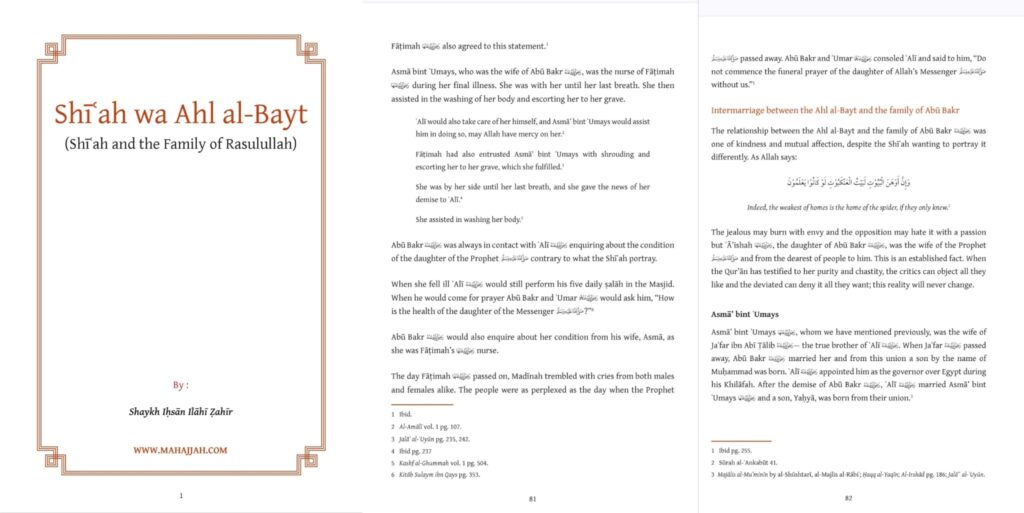
A prime example of this practice is his treatment of a narration attributed to Sulaym ibn Qays. Ihsān Ilāhī Ẓahīr divides the report into isolated parts, attempting to portray harmonious relations (taʿāshīr wa-l-muwāfaqah) between the Ahl al-Bayt and Abu Bakr. He seeks to depict Abu Bakr as consistently concerned about Amir al-Mu’mineen (peace be upon him) and Lady Fatima (peace be upon her). He writes:
“Abū Bakr was always in contact with ʿAlī and would inquire about the condition of the daughter of the Prophet (s), contrary to what the Shīʿah portray. When she fell ill, ʿAlī would still perform his five daily ritual prayers (ṣalāh) in the Masjid. Whenever he came for prayer, Abū Bakr and ʿUmar would ask him: ‘How is the health of the daughter of the Messenger (s)?’” [Shia and Ahl al-Bayt, Mahmud Rida Bajwa, Lahore:Idara Tarjumān al-Sunnah, 2002, p. 81]
This selective presentation deliberately omits the complete content (muḥtawā al-kāmil), which reveals the grievances and profound estrangement between the Ahl al-Bayt and the ruling authorities after the Prophet’s demise. By isolating only those segments that suit his agenda, Ẓahīr misleads readers into believing in a narrative of unity that contradicts overwhelming evidence found in Shīʿah—and even Sunni—sources.
Such tactics betray intellectual honesty and reflect a deliberate effort to obscure the historical record (tadlīs al-tārīkh).
For instance, in a later segment, Ẓahīr cites:
“When Fatima passed away that day, Madīnah trembled with cries from men and women, and the people were astonished as on the day the Messenger of Allah passed away. Abu Bakr and Umar approached, exposing Ali, and said: ‘O Abu al-Hasan! Do not precede us in performing the funeral prayer for the daughter of the Messenger of Allah.’” [Shia and Ahl al-Bayt, p. 81–82]
When the separated parts are read together, the historical context (al-siyāq al-tārīkhī) becomes clear: rather than indicating cordiality, the narration testifies to the estrangement and tension (al-buʿd wa-l-shiqāq) between Abu Bakr, Umar, and Amir al-Mu’minin. Their request not to be excluded from the funeral prayer is not affection but a plea for inclusion, and it occurs after Lady Fatima’s death—demonstrating that they were not even informed beforehand.
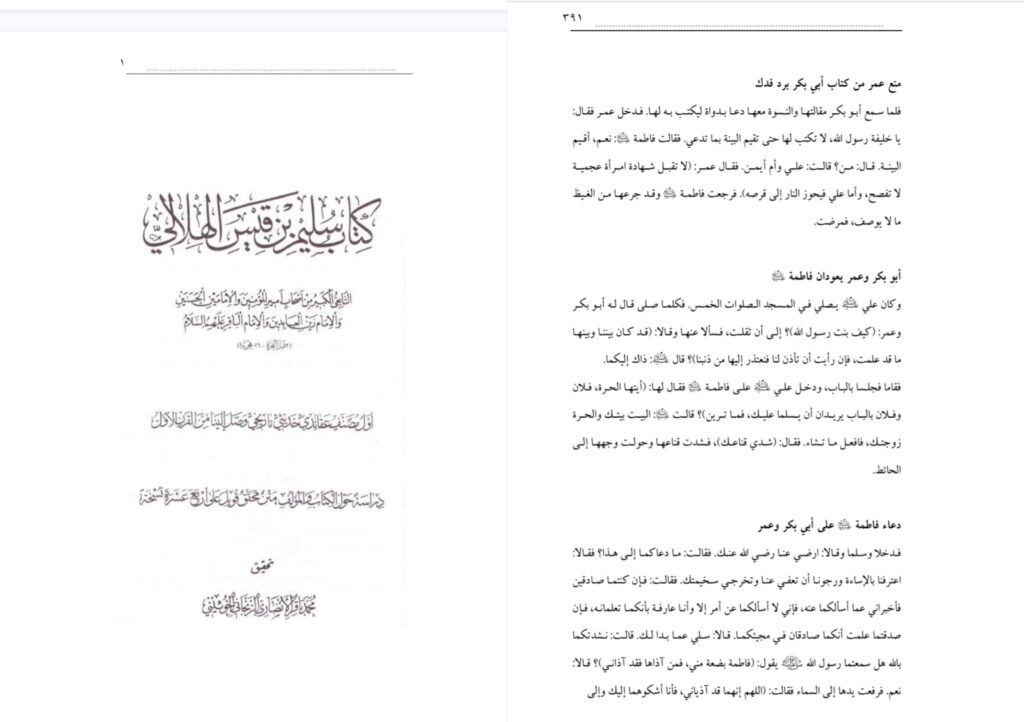
For transparency, the complete Arabic text of the narration(Kitāb Sulaym ibn Qays, p. 391) reads:
Good, thanks for the link. Here is a translation of the relevant portion from Kitāb Sulaym ibn Qays al‑Hilālī, page 391.
And Ali (as) used to pray the five daily prayers in the mosque. Whenever he prayed, Abu Bakr and Umar would say to him: “How is the daughter of the Messenger of Allah?” until her illness grew worse. So they asked about her, saying: “You know what has happened between us and her — if you permit us, we would like to apologise to her for our wrongdoing.” He (Ali) replied: “That is up to you.”
Then they stood up and sat by the door. Ali (peace be upon him) entered to Fatima (peace be upon her) and said to her: “O noble lady, so‑and‑so and so‑and‑so are at the door and wish to greet you—what do you think?” She (peace be upon her) said: “This house is your house, and the noble lady (al-hurra) is your wife; do as you wish.” He said: “Put on your veil.” She put on her veil and turned her face toward the wall.
Then they came in and greeted her, saying: “Be pleased with us, may Allah be pleased with you.” She said: “What brought you to this?” They said: “We admit we wronged you, and we hope you will forgive us and remove your anger.” She replied: “If you are sincere, then tell me what I ask you, for I don’t ask you about anything except that I know you both know about it; if you speak truthfully then I will know you are sincere in your coming.” They said: “Ask what you wish.”
She said: “By Allah, I ask you: did you hear the Messenger of Allah (peace be upon him and his family) say: ‘Fatima is a part of me, so whoever hurts her, hurts me’?” They said: “Yes.” Then she raised her hand to heaven and said: “O Allah, they have hurt me, so I complain of them to You and to Your Messenger …”
Conclusion:
This demonstrates fragmentation and distortion of reports (tamthīl wa-tadlīs al-akhbār) by Ihsān Ilāhī Ẓahīr. He selectively quotes, omits, and splices narrations to present a false image of harmony between the Ahl al-Bayt and Abu Bakr, while the full context unmistakably reveals estrangement and tension (al-buʿd wa-l-shiqāq). Such tactics undermine the reader’s trust, violate principles of scholarly truthfulness (ṣidq al-ʿilmī), and cannot be considered genuine scholarship.